
Custom Home Builder Vancouver BC
Building on the Vancouver Westside is a particular kind of undertaking - regulated in ways that are specific to this city, shaped by neighbourhoods with strong architectural identities, and expected to meet a standard that endures. We build a small number of homes each year, and we approach each one the same way: one Binning principal, your project, from first conversation to final walkthrough.
HPO Licence #43347 · Pacific Home Warranty 2-5-10 · 10+ years building · Vancouver · Lower Mainland · Vancouver Island
What We Bring To The Westside
We take on a small number of homes. That's a considered choice, not a capacity limit.
There's a version of this business that takes on more projects, delegates more of the day-to-day, and grows the way construction companies typically grow. We looked at that model carefully and decided against it.
The reason is straightforward: the work we want to do - custom homes on the Vancouver Westside, built to a standard we'd put our name to without reservation - requires the kind of attention that doesn't scale well. First Shaughnessy Heritage Conservation Area reviews require a builder who knows the process from the inside. A lot with four protected trees and a sloped setback requires someone who's solved that problem before, not someone managing it from a distance. The millwork, the structural details, the decisions that don't show up on the drawings but define how a home feels when you live in it - those require time and presence.
So we cap our projects deliberately. Across all our active locations - Vancouver, the broader Lower Mainland, and Vancouver Island - we take on no more than 5 to 7 custom home builds per year. A Binning principal is on every site personally, every week. That's what the work deserves, and it's the only way we know how to do it well.
A custom home on the Westside is, above all, a long-term thing.
The homes on the streets of Shaughnessy, MacKenzie Heights, and Dunbar that have aged the best share certain qualities: they were designed for the place they're in, built with materials that last, and conceived for the way people actually live rather than the way a sales brochure suggests they should. They didn't try to impress on day one at the expense of how they perform on day five thousand.
That's the standard we work to. Not the home that photographs well before handover, but the home that works well - that's tight, quiet, properly insulated, structurally sound, and still feels right in twenty years. It's a higher bar to build to, and it's the only one we're interested in.
When Harj Binning finishes a project, he asks himself one question: would he live here? The answer has to be yes. That question doesn't change based on who the client is, what the address is, or what the budget was. It's a personal standard applied to every home we build.
The name on the door is also the name on the project.
Binning & Sons is a family business in the direct sense. Harj Binning started it; his sons work in it alongside him. When you engage us, the family members whose name is on the company are the people doing the work - meeting you at the lot, walking the site with the structural engineer, making the call when something needs to be resolved on a Friday afternoon.
There's no account manager between you and the people responsible for your home. The person who quoted the project is the person overseeing the build. The person overseeing the build is the person who handles the warranty. That's not a standard we're trying to improve on - it's the way the business was set up and the way it stays.
Recent Vancouver Builds

Howe — New Westminster 6 bed · 6 bath · open-concept contemporary, two living rooms, high-end appliances and millwork. [View project →]
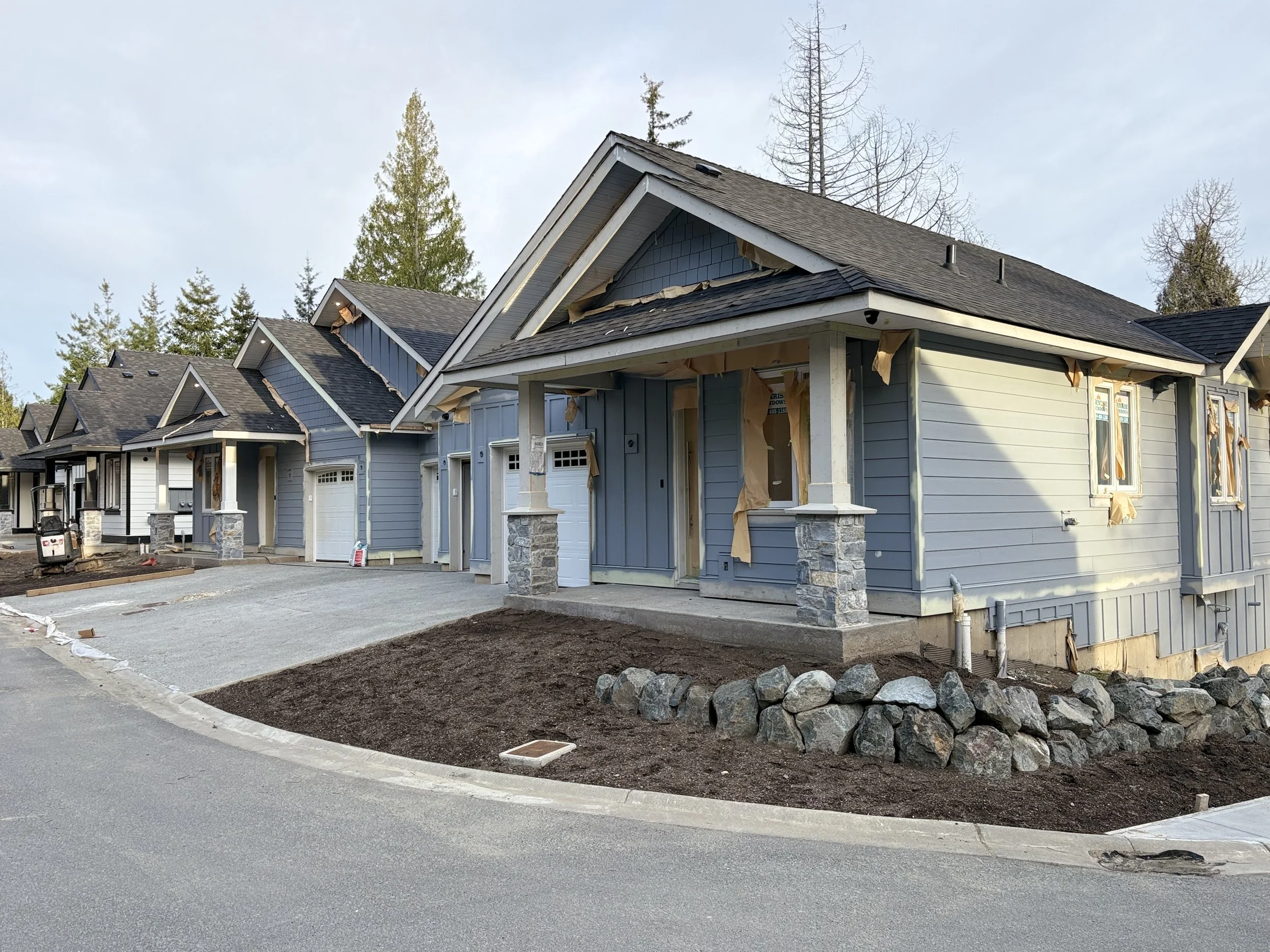
Song Sparrow Way Nanaimo, BC - 4 plex Nanaimo, BC. 3 bedrooms plus flex room, LG professional series appliances, custom showers, engineered floors for modern living [View project →]
Ready To Get Your Project Started?
How a Binning Vancouver Home Gets Built
A custom home on the Vancouver Westside has more layers to navigate than most residential building projects - heritage review in Shaughnessy, tree protection assessments that shape the site plan before design begins, a building bylaw with specific FSR and massing rules, and a permit process that needs to be planned for realistically, not optimistically. We front-load that complexity deliberately. By the time the first trade is on site, the hard questions have been answered.
1. Discovery & site feasibility · 4–6 weeks
The lot comes first. Before any design conversations happen, we need to understand what the site will support and what it won't - and in Vancouver, that assessment is specific to the address.
We review the applicable zone and whether the lot falls within a heritage area, a view corridor, or the First Shaughnessy Heritage Conservation Area, which carries its own set of requirements separate from standard zoning. We identify any significant trees under the City's protection bylaw - their location, their protected root zones, and what that means for the building footprint. We assess slope, ground conditions, servicing, and whether a development permit will be required in addition to the building permit. These are not questions to answer after design has begun.
We also sit down with you and work through what you're actually building: the home you want to live in, the brief you want to give an architect, and the budget that's grounded in reality for this site.
You leave with: a written feasibility memo covering every site-specific constraint and regulatory factor, and a cost range that reflects your actual lot and brief.
2. Design & engineering · 2-4 weeks
With feasibility established, design can begin properly. We work with your architect - or introduce you to Westside designers we have strong working relationships with - and bring the builder's perspective into the design process from the start. The decisions that are easiest to make on paper and most expensive to change in the field happen here: structural system, massing, building envelope performance, and how the home meets the bylaw's FSR and height limits.
We engage structural and mechanical engineers, an energy modeller for BC Energy Step Code compliance, and any specialist consultants the site requires - arborist reports, geotechnical assessments, heritage impact statements for First Shaughnessy projects.
You leave with: permit-ready drawings and a full line-item construction budget, every cost itemised, before any money is committed to construction.
3. Permits & pre-construction · 2–4 months
Vancouver's permit process requires patience and realistic planning. For most Westside projects, this means a building permit application to the City, managed entirely by us. For larger sites or projects requiring a development permit - including virtually all new homes in First Shaughnessy - there's a planning review stage that runs before the building permit application can be accepted. Heritage Review Panel scheduling for Shaughnessy projects adds additional lead time that needs to be designed into the overall programme from the start.
We handle all submissions, respond to information requests, and keep you informed through every stage. We plan around the real timeline for your specific project type and municipality - not the published average, which rarely reflects individual project experience.
You leave with: permits in hand, a signed contract you understand line by line, and a construction programme with dates that have been thought through carefully.
4. Construction · 8–14 months typical (longer for >5,000 sq ft)
From groundbreaking to occupancy. Weekly written site reports with photographs, fortnightly walk-throughs with you on site, and a draw schedule tied directly to the line-item budget approved before construction started. You know what's been spent and what lies ahead at every point in the build.
On large Westside homes with significant glazing, high ceilings, and complex architectural geometry - the conditions that go with ambitious design in this market - building envelope performance is a construction discipline, not just a specification. The mid-construction blower-door test is scheduled from the start and treated as a quality checkpoint, not a compliance formality.
You leave with: a home built to the standard the neighbourhood and the brief called for, tested and inspected before occupancy.
5. Handover & 2-5-10 warranty · ongoing
The walkthrough, the deficiency list, the resolution of anything outstanding. A complete handover package: occupancy permit, warranty documentation, inspection records, and system manuals for every installation in the home. Pacific Home Warranty's 2-5-10 is enrolled from day one of occupancy - 2 years on materials and labour, 5 on the building envelope, 10 on structure. Warranty calls come to us. We resolve them.
You leave with: the keys, and a builder who remains reachable.
Ready To Get Your Project Started?
What's Standard on Every Binning Build
These aren't upsells or premium tiers. They're the baseline for how we work - included on every project regardless of size.
In every build, as standard:
A named Binning principal on your project from first meeting to the end of the warranty period - one person, direct line, full accountability
Written site reports every week throughout construction, with photographs
Fortnightly on-site walk-throughs with you
A full line-item construction budget, maintained and updated as the build progresses
BC Energy Step Code compliance including energy modelling and mid-construction blower-door testing
Independent final air-tightness verification by an energy advisor before occupancy
Pacific Home Warranty 2-5-10 enrolment, automatic on every build
Direct warranty support through the full coverage period - no third-party intake
What we price separately - and why:
These items vary too much by lot, brief, and specification to bundle at a standard figure. Every one is its own line in the construction budget, with the assumptions behind it explained:
Architectural design - through your architect or our Westside design partners
Geotechnical investigation where required by site conditions
Arborist reporting - required on most established Westside lots under the City's tree protection bylaw
Heritage impact assessment for First Shaughnessy projects
Structural, civil, mechanical, and environmental consultants beyond standard scope
Landscaping and outdoor living above a baseline package
Pool, spa, sauna, cold plunge, and wellness rooms
Smart home and audio-visual systems above a standard package
Secondary suites or additional units
What a Custom Home Costs to Build in Vancouver in 2026
Construction costs on the Vancouver Westside vary a lot, depending on finish specification, structural complexity, site conditions, and energy performance level.
Here's what actually moves the figure on a Westside project.
The site. Slope, ground conditions, and what the survey reveals all have construction consequences. Retaining, drainage engineering, foundation systems on rocky or variable terrain - these aren't things that can be standardised in a square-foot rate. A geotechnical assessment on your specific lot, at the feasibility stage, is the only way to price them accurately.
Finish specification. Millwork complexity, stone and tile programmes, glazing packages, hardware, appliances, joinery, and lighting design are where budgets vary most significantly on projects of comparable structural scale. We help clients understand where specification choices have the most impact on the finished experience - and where additional spend doesn't register the way the cost might suggest.
Protected trees and what they require. A lot with mature trees under the City's protection bylaw may need its building footprint, underground parking, or foundation designed around root protection zones. That affects the structural system and sometimes the massing of the home - costs that flow directly from the site and show up in the budget only once the arborist has assessed the lot.
Heritage requirements. First Shaughnessy projects involve architectural design work and a consultant scope that non-heritage projects don't. Heritage impact statements, Heritage Review Panel submissions, and the design iteration that comes with heritage review are real costs that belong in the budget from the start.
Vancouver's permit fees and development cost charges. The City of Vancouver's permit fee schedule and development cost charges are among the highest in the region. These are real project costs that need to be in the budget from the feasibility stage - not absorbed as a surprise after construction starts.
FSR and envelope design. Getting the most from Vancouver's permitted floor-space ratio - typically around 0.60–0.70 for Westside residential - requires deliberate design work on basement configuration, ceiling heights, and how the building mass is organised. The difference between a home that uses its envelope well and one that doesn't often doesn't show up as a line item. It shows up in how the home lives.
Energy performance. Step 3 of the BC Energy Step Code is today's mandatory floor; Step 5 becomes mandatory province-wide by 2032. Building to Step 5 now costs more upfront, performs measurably better over the life of the home, and positions the building ahead of code rather than behind it. We model both levels and provide real numbers so the decision can be made with full information.
Timeline. From first discovery meeting to occupancy, plan for 15 to 28 months on a Westside project. Design and engineering, Vancouver's permit process, and construction each take the time they take - and a project managed to a realistic schedule is a different experience from one chasing an optimistic one.
Where We Build on the Vancouver Westside
Each Westside neighbourhood has its own building character - different regulations, different architectural context, different site conditions. Understanding those differences is part of what it means to build here well.
Shaughnessy
Shaughnessy is Vancouver's most storied residential address, and building here carries responsibilities that other Westside neighbourhoods don't. First Shaughnessy is designated a Heritage Conservation Area - the only one of its kind in the City for residential new construction. New homes, demolitions, and significant alterations require approval from the City's Heritage Review Panel, in addition to the standard building permit process. The Shaughnessy Heights Building Restriction Act imposes controls on allowable height and building mass that are separate from and more restrictive than standard Vancouver zoning.
Lots here are substantial - quarter-acre and above - and the homes they support need to belong in a streetscape of Tudor Revival estates and Edwardian originals. That's not a constraint, it's an invitation to build something that earns its place. The clients working on Shaughnessy projects tend to have a clear sense of what they want and the patience the process requires. So do we.
Point Grey / West Point Grey
Point Grey Road is among the most valuable stretches of residential real estate in Canada, and the neighbourhood above it - across the bluffs toward UBC - has become one of the city's most active settings for architecturally serious custom home building. Lots range from generous inland parcels to ocean-facing properties looking across the Strait of Georgia to the North Shore mountains.
Building toward the water on this side of the city requires careful structural and glazing engineering - Pacific weather exposure, the structural requirements of significant cantilevers and view-oriented glazing packages, and the specific demands of an elevated coastal site. These are well-understood problems with established solutions. They're just solutions that need to be designed in from the beginning, not added on during construction.
MacKenzie Heights
MacKenzie Heights sits between Dunbar and Kerrisdale and delivers what many Westside buyers are actually looking for without the noise that surrounds more prominent neighbourhoods: generous lots by City of Vancouver standards, a quiet and well-established residential character, and proximity to the amenities that make the Westside what it is. The homes being built and rebuilt here tend to be long-term family homes rather than landmark projects - thoughtfully designed, well-constructed, and built to be lived in for decades.
The neighbourhood's mature canopy is part of what makes it appealing and a factor that needs to be worked with. Many MacKenzie Heights lots have trees that fall under the City's protection bylaw, and a site feasibility assessment that identifies those trees before design begins is the straightforward way to avoid complications later.
Dunbar
Dunbar's character comes from the combination of its physical fabric - mature trees, a mix of traditional and contemporary homes, wide residential streets - and its community life. It's a neighbourhood that rewards architectural sensitivity: new builds tend to read best when they've been designed with the context in mind rather than against it, and the clients commissioning them here typically have a clear sense of that.
Tree protection is, again, a factor on established Dunbar lots with significant canopy. Site assessment before design is a straightforward step that prevents the more complicated version of the same conversation later in the project.
Kerrisdale
Kerrisdale has an active custom home market - teardowns and rebuilds are common, and there's no shortage of recent work in the neighbourhood to serve as reference. That creates a calibrated buyer: clients commissioning custom homes in Kerrisdale tend to know the difference between a home that's been built well and one that merely looks it. Entry-level detached homes start around $2.5M; serious estate projects run considerably above that.
The neighbourhood's traditional character is a useful frame for design. Contemporary architecture integrates well here when it respects scale and the relationship to the street - the best recent builds in Kerrisdale read as being of the neighbourhood, not arrived in it.
Kitsilano - Point Grey Road
Most of Kitsilano operates at a different residential scale and tenure from the neighbourhoods above. Point Grey Road - the oceanfront strip at the base of the neighbourhood - is the exception: a concentration of some of BC's most significant private addresses, with properties that belong in the same category as Shaughnessy and West Point Grey in terms of value, scale, and architectural ambition. When we include Kitsilano in a Westside context, that's the part of it we're referring to.
What Building in Vancouver Involves
The City of Vancouver operates its own building bylaw, its own planning requirements, and its own environmental regulations - most of which are specific to the City and don't apply in the same form elsewhere in the region. Understanding these before the design starts, rather than encountering them during permitting, is the practical difference between a project that runs smoothly and one that doesn't.
First Shaughnessy Heritage Conservation Area
First Shaughnessy is the only Heritage Conservation Area in Vancouver designated for residential new construction. It operates under two layers of regulation that work in addition to the standard development and building permit process: the requirements of the Shaughnessy Heights Building Restriction Act, which governs maximum building height and lot coverage, and the City's heritage bylaw, which requires Heritage Review Panel approval for new construction, demolitions, and significant alterations.
In practice, this means a formal design review before the building permit application is accepted, a Panel scheduling process that adds time to the overall programme, and design submissions that must demonstrate compatibility with First Shaughnessy's established architectural character. Heritage Revitalization Agreements are required on certain sites. All of this is manageable - but it needs to be built into the project timeline and budget from the outset, and it requires a design team and builder who have navigated it before.
FSR, Massing, and the Vancouver Building Bylaw
The Vancouver Building Bylaw sets the allowable floor-space ratio (FSR) for a custom home on a Westside lot - typically 0.60 to 0.70 for single-family residential zoning. On a 7,000 sq ft lot, that means roughly 4,200 to 4,900 sq ft of permitted floor area. The bylaw also governs building height, setbacks from property lines, and the relationship of the building mass to the street.
Working well within that envelope - making a home that feels generous, functional, and well-proportioned rather than a building that has simply used its allowance - is a design and construction exercise that benefits from detailed bylaw knowledge applied from the concept stage. We bring that knowledge into design conversations as a working constraint, not a bureaucratic checklist.
BC Energy Step Code and Zero Carbon
Step 3 of the BC Energy Step Code is the current mandatory floor for all new residential construction in BC. It requires an energy model, a mid-construction blower-door air-tightness test, and independent final verification before occupancy. Step 5 - equivalent to Passive House performance - becomes the mandatory standard province-wide by 2032.
On a large Westside home with complex geometry, significant glazing, and high ceiling volumes, building envelope performance is not a simple compliance exercise. It requires the architect, structural engineer, mechanical designer, and energy modeller to work from the same set of assumptions from the design stage onward. We coordinate that process.
Since March 2025, the Zero Carbon Step Code's EL-1 requirement applies to all new BC homes - in practice, heat-pump-ready all-electric mechanical systems are now the standard design basis on every Binning home.
Vancouver's Urban Tree Protection Bylaw
Vancouver protects trees that meet a defined size threshold - measured by trunk diameter at breast height - from removal without a City permit. These permits are frequently denied for healthy trees, regardless of where they fall on a lot. On most established Westside sites, there will be trees that qualify for protection.
When a protected tree's root protection zone overlaps with a proposed building footprint, underground parking, or driveway, the design needs to work around it. This is an entirely solvable problem - but the solution needs to be part of the brief before the architect draws the scheme, not a response to a permit condition after the design is done. We commission an arborist report as part of our standard site feasibility work for exactly this reason.
Development Permits and Building Permits
Many Westside custom home projects require both a development permit and a building permit - two separate applications processed by different City departments, in sequence. The development permit, handled by the Planning department, must be approved before the Building department will accept a building permit application. For First Shaughnessy projects, this is a near-certainty. For other Westside lots, it depends on site characteristics and the scope of the project.
Planning for both permits from the outset - and building the development permit timeline into the overall project programme - is the correct way to schedule a Vancouver custom home project. Building in only one permit timeline is a common source of schedule surprises.
Get in Touch
Whether you have a question, an idea, or just want to say hello, feel free to reach out—we’re here to help.
Frequently Asked Questions
-
Construction costs on the Vancouver Westside currently range from $500 to $1,100+ per square foot, depending on finish specification, structural complexity, site conditions, and energy performance level. A well-specified 3,500 sq ft home in Kerrisdale or MacKenzie Heights would typically sit between $1.8M and $2.8M in construction costs. A larger Shaughnessy project with heritage design requirements and a premium finish programme runs higher.
Land is separate - Westside lots typically add $2M to $5M or more before a shovel goes in the ground. Total project investment including land, design, permits, and construction on a serious Westside commission routinely sits between $4M and $12M. After a discovery meeting, we provide a written cost framing specific to your lot and brief.
-
From first meeting to occupancy, plan for 15 to 28 months on a Westside project. The breakdown in broad terms: 4–6 weeks of discovery and feasibility, 3–5 months of design and engineering, 3–5 months of permits (longer for First Shaughnessy projects requiring Heritage Review Panel scheduling and a development permit), and 8–14 months of construction. Vancouver's building department processes applications on timelines that vary by project type - we plan around the realistic window for your specific project from the start.
-
First Shaughnessy is the only Heritage Conservation Area in Vancouver designated for residential new construction. Any new home, demolition, or significant alteration in the area requires approval from the City's Heritage Review Panel in addition to the standard building permit process. The Shaughnessy Heights Building Restriction Act applies additional controls on allowable height and building mass beyond standard Vancouver zoning, and Heritage Revitalization Agreements are required on certain sites.
In practical terms this means a longer permit programme, a design review process specific to heritage compatibility, and a project that needs an experienced architect and builder who have worked in this context before. It's entirely workable - it just needs to be planned for properly from the start.
-
The City's protection bylaw covers trees meeting a minimum size threshold, measured by trunk diameter, and prohibits their removal without a City permit. Those permits are frequently declined for healthy trees. On established Westside lots - which is most of them - there will typically be protected trees, and any that have root protection zones overlapping a building footprint, driveway, or underground structure may require the design to work around them.
We commission an arborist report during site feasibility, before design begins, so that tree constraints are in the brief from day one. It's a straightforward step that removes a significant source of mid-project complications.
-
FSR - floor-space ratio - is the relationship between a lot's area and the permitted total floor area of the building. For most Westside single-family lots, the allowable FSR for a custom home is approximately 0.60 to 0.70. On a 7,000 sq ft lot, that translates to roughly 4,200 to 4,900 sq ft of floor area. The bylaw also governs height, setbacks, and massing.
Getting the most livable and well-proportioned home within that envelope is a design exercise that benefits from detailed knowledge of how the bylaw is interpreted and applied. We bring that into the design process as a working constraint from the concept stage.
-
Often yes, and it's important to plan for both. Development permits are processed by the City's Planning department and must be approved before the Building department will accept a building permit application. First Shaughnessy projects require a development permit for virtually every new home. For other Westside lots, whether one is required depends on site specifics and project scope. Building in only one permit timeline to a project programme is a common cause of schedule surprises - we assess this at feasibility and plan both timelines from the start.
-
A general contractor manages construction based on drawings and specifications prepared by others. A custom home builder takes responsibility for the whole process - design coordination, engineering, permitting, the build, and the warranty. The distinction is accountability: one party owns the outcome from lot to handover. With a GC model, the integration between designer, engineer, and contractor is typically the homeowner's risk to manage.
-
Yes. BC's Homeowner Protection Act requires new homes to be built by a Licensed Residential Builder registered with BC Housing's Homeowner Protection Office. Binning holds HPO Licence #43347. Every home we build is automatically enrolled in Pacific Home Warranty's 2-5-10. You can verify any BC builder's current licence on the BC Housing Licensed Builder Registry.
-
Two years on defects in materials and labour. Five years on the building envelope - water penetration through walls, roof, windows, and foundation waterproofing. Ten years on structural defects, including the foundation and load-bearing elements. Every Binning home is enrolled at occupancy. Warranty calls come to us directly. We handle them.
-
First Shaughnessy's Heritage Conservation Area designation puts it in a separate regulatory category from every other Westside neighbourhood. Heritage Review Panel approval, the Shaughnessy Heights Building Restriction Act, and in some cases Heritage Revitalization Agreements create a permitting process and design brief that has no direct equivalent elsewhere in the City. Lots are larger, but the design latitude is shaped by heritage compatibility requirements that don't exist in Kerrisdale, Dunbar, or MacKenzie Heights.
Those other neighbourhoods operate under standard Vancouver residential zoning - the same FSR rules, tree protection bylaw, and building permit process, but without the heritage overlay. The primary site-planning consideration in each case tends to be tree protection on lots with established canopy. The standard for design and construction quality is high throughout the Westside, regardless of neighbourhood.
-
Yes, and we do this regularly. If you have an architect whose design you're committed to, we join the project as builder of record and bring construction knowledge into the process from whatever point we come on board. If you're approaching design fresh, we can introduce you to Westside architects and designers we have established working relationships with. Either way, a named Binning principal is attached to your project from first meeting through to handover.
-
No more than 5 to 7 across all our active locations - Vancouver, the Lower Mainland, and Vancouver Island. That ceiling is deliberate. The commitment to have a Binning principal on every project personally, every week, only works if the total number of concurrent builds stays manageable. We'd rather have a waitlist and build things well.
-
Questions worth putting to any builder you're evaluating, including us:
What is your BC Housing Licensed Residential Builder number, and how long have you held it?
Which 2-5-10 warranty provider do you use?
Who will physically be on my site, and how often will I see them?
Have you built in the specific neighbourhood where my lot is?
Can I see a complete line-item budget from a comparable recent project?
How many active projects are you running concurrently right now?
If the project is trending over budget during construction, at what point do I hear about it?
Can you connect me with two clients whose homes you've completed in the past 12 months?
-
Yes - with an active track record there. Recent and current Lower Mainland builds include projects in New Westminster, South Surrey, White Rock, and across the region. Our /custom-home-builder page covers the Surrey and Mainland work in detail. If you have a project outside Vancouver city limits, we're still worth a conversation.
Ready To Get Your Started?